Tuesday, March 8, 2011

Not Free Unless the Courts Agree!


A recent Supreme Court ruling affirming free speech rights in a controversial case, one pitting freedom of religion against freedom of speech, comes as no surprise, but what was surprising was the one judicial hold out, the lone dissenter, associate justice Samuel Alito.

You remember Justice Alito, the lone dissenter again (ostensibly, that is), during one of Obama's presidential speeches before congress, shaking his head and possibly mouthing the words, "not true," to a statement Obama made expressing disapproval of a recent Supreme Court ruling.

Thanks to that controversial free-speech ruling, we can all rest easy tonight snug in the assurance that our free speech rights will continue unabated and untarnished.

Corporations can continue, without fear of reprisal, to spend massive amounts of money to influence the outcome of elections and the viability of certain legislation; Sara Palin, the run-away Alaskan governor, can continue to insist that President Obama "pals around with terrorists;"[1] Mike Huckabee, an ordained minister, can continue to say falsely (forgetting: "Thou shalt not bear false witness against thy neighbor.") that president Obama grew up in Kenya and was heavily influenced by his father and grandfather who opposed British imperialism;[2] and Michele Bachmann, the flower of American patriotism, can continue to cast the president as un-American, and his administration as "gangster-"like.[3]

Of course they do it, because there's a segment of the population that thrives on this mendacious fare, and upon whom much of it is heavily lavished: it sells millions of books, if you're Huckabee, Palin, and George Bush;[4] sets you up as a Tea Party Caucus leader of a rather "anemic" group, if you're Michelle Bachmann[5]; and puts millions of dollars into political war chests, if you're Scott Walker, or a growing number of other politicos, Scott Brown, for example, vying to be the political darlings of the Koch brothers.[6]

Rights are rights, but oftentimes they conflict. For example, when does our right to express our religious beliefs, vouchsafed by the same document that guarantees our freedom to speak, takes precedence, if, and when, those rights clash, as in this case? To my knowledge there's no hierarchy of rights. As such, they all stand firmly on an equal footing, one independent of the other.

If we take reckless liberties with the right to speak (in this case in writing or print, or on a sign), we may be accused of libel, brought into court and sued. This is a limit to free speech that all courts recognize and support. But since the decedent in this case, once dead, has no reputation to protect, and, therefore, cannot suffer an infliction where damages may be assessed, the case is moot.

If we take reckless liberties, as did the Westboro Pastor Fred Phelps and other church members, that encroach upon a person's right to bury a loved one according to the precepts of his religion, then that expression is protected, all the way to the Supreme Court:

"In a case pitting free-speech versus privacy rights, the nation's highest court held that the picketing at a private funeral and even hurtful protest messages were protected by the U.S. Constitution's First Amendment.

"The decision by an 8-1 vote was the latest in a long line of Supreme Court rulings that free-speech rights protected even outrageous or offensive conduct, including the burning of the American flag.

"The ruling was a defeat for Albert Snyder, the father of a Marine killed in Iraq in 2006. He sued after the family's funeral service at a Roman Catholic Church in Westminster, Maryland, drew unwanted protests by members of the Westboro Baptist Church in Topeka, Kansas."[7]

Although one of the pillars of our democracy has been strengthened by this ruling, not all are satisfied with the outcome, and have been rather vocal with their opposition. Under the title, Schieffer: First Amendment Rights Gone Too Far?, Bob Schieffer gives expression to my view as well:

"(CBS News) I've spent most of my life defending the First Amendment. But when the Supreme Court ruled last week that it gave a church group the right to picket a dead soldier's funeral with signs that said, "God Hates You" and "Thank God for Dead Soldiers," I was appalled.

"The group believes our soldiers are dying because God is punishing America for tolerating gay people. That anyone would have the audacity to claim knowledge of God's reasoning is ridiculous, but here's what I don't understand.

"The courts have long held that free speech can be limited in rare circumstances. We can't yell fire in a crowded theater if there is no fire, because it would endanger public safety - people might be trampled in the chaos.

"The First Amendment has done just fine with that limit.

"But if that is so, why isn't public safety endangered when a mob hurls brutal abuse at an innocent citizen who could be scarred with severe and lasting emotional damage?

"We must obey the law, because we are a nation of laws. But whatever the laws, what these military families have endured is not right, and every community must now move quickly to establish buffer zones (which are legal) to keep these protesters as far as possible from military funerals.

"When there are those among us so selfish and cruel they are willing to use one of our most cherished freedoms to intrude on the grief of parents who have lost a child just to promote their cause, we must do everything legally possible to deter them.

"The court has ruled, but the effort to protect these families must go on."
[8]


[1]"Palin said today, according to a transcript distributed by the campaign. 'These are the same guys who think patriotism is paying higher taxes. This is not a man who sees America as you and I do — as the greatest force for good in the world.

"'This is someone who sees America as imperfect enough to pal around with terrorists who targeted their own country,' Palin concluded, in the hardest shot of the statement."

[2]"Former Arkansas Gov. Mike Huckabee says President Barack Obama's childhood in Kenya shaped his world view -- despite the fact that Obama did not visit Kenya until he was in his 20s.

"The potential Republican presidential candidate told New York radio station WOR that Obama was raised in Kenya with a Kenyan father and grandfather.

"Actually, Obama was born in Hawaii in 1961 to a mother from Kansas and a father from Kenya whom he would barely know. He spent his youth in Hawaii and Indonesia and did not visit his father's homeland until 1987, well after his father's death."

[3] "MR. GREGORY: You, you've referred to the Obama administration as a gangster government. You've said that this president has anti-American views. Do you believe that still?

"REP. BACHMANN: I believe that the actions of this government have, have been emblematic of ones that have not been based on true American values. Just consider Obamacare. Over 900 waivers have been given out to unions and protected special interests that are linked to the president. That's not right."

[4] "'America by Heart,' Palin's new memoir, has logged disappointing receipts since it officially went on sale late last month, publishing sources say. Although the book is second on the New York Times bestseller list this week (behind former president George W. Bush's memoir, "Decision Points") , its publisher, HarperCollins, hasn't ordered a second printing - a sign that sales haven't been overly brisk.

"By contrast, Palin's first book, "Going Rogue," became the second-fastest-selling political book in history upon its release last year, according to Nielsen BookScan, which tracks industry sales. It went into a second printing three days after its release and went on to sell 2.2 million copies in hardcover, according to the publisher."

[5] "That is pretty anemic! In fact, it means that Tea Party Caucus ranks have actually diminished under the "leadership" of Cuckoo for Cocoa Puffs Michele Bachmann (R-MN-06), which is really remarkable given the constant fluffing the Teabagger contingent gets from the national press. Seriously, who would have guessed that there would be fewer members of the caucus in this Congress versus last?"

[6] "At the public dedication of MIT’s David H. Koch Integrative Cancer Institute last Friday, Sen. Scott Brown (R-MA) effusively thanked conservative billionaire David Koch for supporting his election in 2010 and made a plea for help in his re-election campaign next year."
[Watch exclusive video here.]

[7]

[8]

Tuesday, February 22, 2011

Dread Scott

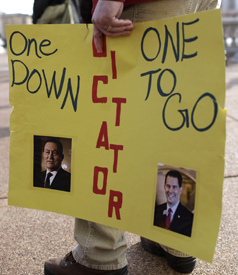
Hosni Mubarak & Gov. Scott WalkerI write a lot about the American dream, and how we expend our time and energy in pursuit of it. The "dream," itself, isn't good or bad, it's just a dream. What makes it either good or bad, is what we give up to attain it. If we give up integrity in the pursuit, it's bad. If we give up what's good and decent in our being, it's very bad.

Sometimes, the price that's paid to realize the dream becomes bigger and more expensive than the dream itself.

In walks Scott Walker, governor of Wisconsin. Assuming the office on January 3, 2011 Walker has already made a splash with his party, and has grabbed a large portion of the national mega-media spotlight. Palin did it by becoming John McCain's running mate. Walker is doing it by becoming the first Republican governor to challenge his state's time-honored reverence for employee unions. Other Republican governors are expected to follow his lead.

A recipient of Koch brothers money during his run for the governorship, Scott Walker came to the position bought, if not bossed. Barack Obama is often described as a Manchurian candidate. We could say, with a measure of accuracy, that most elected officials, those who have taken vast sums of money from a cadre of donors knowing full well that pay-back is expected, or, once in office, taken large sums of money from lobbyists with similar goals, are effectively Manchurian candidates. The difference: these public officials knowingly do the wishes of their benefactors; a Manchurian candidate, unknowingly.

I put Governor Scott Walker in the "knowing" category.

Thank you, Wisconsin Governor Scott Walker, for waking a sleeping giant.
Thank you for the awesomely uplifted spirits of Wisconsinites from Superior to Kenosha and Eagle River to Platteville, who trekked to the state capital to defy your union-busting grab.

Thank you for the caravans from North Carolina and New Jersey and Utah who came to a small city in the Snowbelt to join the cause. They know this is not Wisconsin's fight alone. They know that in fifty states, we all are targets of a nasty national conspiracy to destroy unions and the middle-class society unions have built.
Thank you for those whose signs proclaim, "Former Republican."

Gov. Walker, when you concocted a fake budget crisis to have an excuse to rush a union-busting bill through the Legislature, you showed yourself to be as deaf as the Hosni Mubarak so many signs have compared you to.

I've never felt so rejuvenated as when marching with thousands on cold evenings in Wauwatosa and Menomonee Falls shouting, "This is what democracy looks like." It evoked my memories of long-ago marches for civil rights at home and peace in Vietnam.
[1]

This much I know: Were it not for unions, the American dream which undergirds American exceptionalism, a term we hear thrown about now with the ease of a baseball, would not be something in which this country takes pride. Unions gave us 40-hour work weeks, weekends, pensions, and other concessions from Big Business, hard-won worker benefits too innumerable to recount.

I don't happen to believe, as some Republicans do, that unions are bad--bad for businesses, and bad for America. Without unions, compensation for a days' work would have been at the pleasure and munificence of employers. The rise of the middle class would have looked more like a molehill, than a rolling hill, and American exceptionalism and the American dream wouldn't have entered our national, political lexicon.

George Carlin, now deceased, says it best in the following video clip. "A high school dropout, Carlin enlisted in the army, [where he] got his high school equivalency....[O]n June 22, 2008, Carlin died of heart failure," most likely the result of a broken heart, given the deep disappointment he carried for his beloved country.

Although a comedian, Carlin had a Solomon's wisdom grasp of the American condition and an amazing insight into what makes our country tick, and what is needed to seize the American dream.


The audience laughed, clapped wildly, and cheered. It would have been better had they resolved to be M.A.D. as hell, but they weren't. Under the heading of TrUSt?, I warned that government shouldn't receive our unquestioning trust.

On another blog, I posted this observation on the current political scene unfolding before us:

Unfortunately, politics is a game. It’s a game that’s played for the players and not for the spectators, who can find their fortunes reversed and sacrificed so that the players can assure a win.

The difference between Repubs and Dems is that the Dems don’t play as ruthlessly as the opposing team: they usually follow the rules of the game, don’t foul as often, and believe that the spectators should have some stake in the outcome of the game. But make no mistake about it, Dems are as eager to play for the sake of the team, as Repubs, but Repubs are out to play for themselves and themselves only, and the spectators be damned, if they get in their way.


[1]

Monday, February 7, 2011

The "Father of Black History"


This is Black History Month. It was once known as Negro History Week. Rather than highlight Martin Luther King Jr, and other civil rights leaders this year, I thought I'd take a closer look at the founder of this national observance, Carter G. Woodson.

I have Woodson to thank for all those stern black faces on posters that once a year, during Negro History Week, looked down upon me disapprovingly, as I walked the halls of my high school.

How would I ever live up to the fierce demands that those inquiring eyes imposed upon me, a mere lad of the south?

Perhaps this was why Woodson founded Negro History Week: to sear into the black consciousness a challenge that asked: "How will you use your life to continue the work that these civil-rights stalwarts and pioneers began and you inherited?"

For his part, Woodson is rarely mentioned in the context of black history, nor is he given proper credit for his contribution to Black History Month. This year I wanted to make up for this oversight. You'd think that the person responsible for Black History Month would, at the very least, receive some "love", too, during this time of the year.

In the spirit of doing my part to restore Woodson to his rightful place in black history, and as the "Father of Black History," and the founder of what is now Black History Month, let me offer this background information--a brief summary of his life as a gifted scholar, and educator, and as an unlikely activist:

Carter Godwin Woodson founded The Journal of Negro History in 1916 and began Negro History Week (later Black History Month) in 1926, earning him the nickname "The Father of Black History." The son of enslaved African Americans, Carter Woodson earned undergraduate degrees at Kentucky's Berea College in 1903 and at the University of Chicago in 1907. He also studied at the Sorbonne in Paris, and after he earned a graduate degree at Chicago (1908), he went on the earn his doctorate in History from Harvard University in 1912.

Woodson taught in public schools in Washington, D.C. and served as a dean at both Howard University and the West Virginia Collegiate Institute. But his greatest impact was as the leader of the Association for the Study of Negro Life and History, an organization he founded in Chicago in 1915. (The name was changed to the Association for the Study of African American Life and History -- ASALH -- in 1972.) Woodson and his colleagues were energetic advocates for the study of black history as its own field, and they spread the word through their Journal, as well as through articles in Marcus Garvey's Negro World, public lectures and an ambitious community outreach program that welcomed students and non-academics. He also used the study of history as a spark for social activism, as evidenced in his most famous book, The Mis-Education of the Negro (1933).

Carter Woodson began Negro History Week in 1926, designating a week in February, because that month held birthdays for Abraham Lincoln, Frederick Douglass and Booker T. Washington. That went on to become Negro History Month and then Black History Month, designated as February each year by presidential proclamation. Carter G. Woodson's other books include A Century of Negro Migration (1918), A History of the Negro Church and The Negro in Our History (1922).

Carter G. Woodson was the second African American to earn a Ph.D. at Harvard -- the first was W.E.B. DuBois... Woodson served as an education administrator in the Philippines from 1904 to 1907... He launched the publication The Negro Bulletin in 1937 as a way to reach younger audiences... President Gerald Ford began the tradition of declaring February to be Black History Month in 1976.

Wednesday, February 2, 2011

Wall-ed Street? No more!

For most of the day, MSNBC televised pictures from a part of the crime scene, Tahrir Square in Cairo, Egypt, as Molotov cocktails from a bridge rained down upon anti-Mubarak protesters.

I say part of the crime scene, because the full crime scene extends far beyond the Square, and Egypt, to embrace most of the world, including the United States.

The most perfect crime is one where no suspicion is raised, and the perpetrator escapes the long-arm of the law (now shorter, by design), and is never brought to justice.

We saw evidence of the crime months ago, August of last year to be exact, but little was done then to prevent further crimes from taking place, or to soften the blow to potential victims:

Wheat prices continue to rise as Russia has set a ban on the exports of the crop. Wheat hit a 23-month high of $8.25 and the price could go higher. It is not clear if yields from farms, particularly in Canada and the US, can make up the shortfall. The perception is that demand will outstrip supply this year. Wheat futures are up nearly 25% this week based on that assumption.

The question arises over how much the shortage is to blame for the run-up and how much comes from simple speculation. In mid-2008, crude futures rose from $80 to $140, and that was not solely the result in an imbalance between supply and demand. Oil prices may have been artificially inflated, but that did not keep gasoline prices from spiking and that undercut profits in fuel-dependent sectors like airlines. It also took gasoline prices to over $4 a gallon, which made life for average Americans even worse than the recession alone.

Crude prices moved back down as speculators took profits.

The price of wheat will cause at least temporary inflation in food prices including bread and cereals. Inflation in the US is low now, but so is the rate at which real wages are growing. Any cost burden put on consumers due to higher food prices is likely to cut purchases of other goods and services.


If you're the sleuth I think you are, you have already identified both the crime, and the perpetrators--Wall Street speculators. Wall Street not only created the economic meltdown we're experiencing here at home, but it contributed to the world-wide woes gripping other parts of the world.

If you take another step back, you'll see that capitalism--as it is currently run by unscrupulous corporatist practitioners, recently freed from the bars of restraint that once held them in check--is the overarching criminal:

As Nouriel Roubini who was among the first to predict the financial crisis while others were pooh-poohing him as “Dr Doom” says don’t just look at the crowds in Cairo but what is motivating them now, after years of silence and repression.

He says that the dramatic rise in energy and food prices has become a major global threat and a leading factor that has gone largely unreported in the coverage of events in Egypt.

"What has happened in Tunisia, is happening right now in Egypt, but also riots in Morocco, Algeria and Pakistan, are related not only to high unemployment rates and to income and wealth inequality, but also to this very sharp rise in food and commodity prices," Roubini said.

Prices in Egypt are up 17% because of a worldwide surge in commodity prices that has many factors but speculation on Wall Street and big banks is a key one.


Here's the big question: How long will it be before the excesses of our economic system, and this rapacious Wall Street criminal--the one we have locked up from time to time, and walled, where appropriate, with various laws and regulations--plunge us all into a Third World War?

Wednesday, January 26, 2011

"create the conditions that promote"


Paul Ryan's response to President Obama's State of the Union address, representing the official GOP response, stuck pretty close to Republicans stated, but not always practiced, view of government, and our Constitution:

We believe government's role is both vital and limited — to defend the nation from attack and provide for the common defense ... to secure our borders ... to protect innocent life ... to uphold our laws and Constitutional rights ... to ensure domestic tranquility and equal opportunity ... and to help provide a safety net for those who cannot provide for themselves.

We believe that the government has an important role to create the conditions that promote entrepreneurship, upward mobility, and individual responsibility.

We believe, as our founders did, that "the pursuit of happiness" depends upon individual liberty; and individual liberty requires limited government.

Limited government also means effective government. When government takes on too many tasks, it usually doesn't do any of them very well. It's no coincidence that trust in government is at an all-time low now that the size of government is at an all-time high.

The President and the Democratic Leadership have shown, by their actions, that they believe government needs to increase its size and its reach, its price tag and its power.


Under a Republican president and a Republican congress, Republicans violated what Ryan states is a "vital and limited" role of government--"to uphold our laws and Constitutional rights"--by spying on Americans and resorting to torture, as unreliable as that method is, when it comes to extracting actionable intelligence from detainees.

In addition, Some Republicans are considering a revisit of the Constitution, declaring that parts of it, the fourteenth amendment in particular, begged to be reconsidered, to undergo a new interpretation, in light of the many children of undocumented immigrants who have been born, and now reside in, the nation.

Although subject to Republicans pressing a "reinterpretation," Ryan's reference to providing "a safety net for those who cannot provide for themselves," startled, almost as much as the anachronistic placement of a cellphone at Lincoln's Gettysburg Address. It not only seemed out of place for a Republican, but clearly out of character. In the months ahead, I'm sure Ryan will be given many opportunities to expound on his meaning, given that Tea Party activists would like nothing better than to slash away at Social Security and Medicare, and end government's involvement in these two entitlements altogether by privatizing it.

In place of "promote the general welfare," Ryan particularized this part of the Preamble to the US Constitution by stating without ambiguity what he believes "general Welfare" to mean--nothing short of, and to the exclusion of all other, "entrepreneurship, upward mobility, and individual responsibility."

Entrepreneurship, and upward mobility is promoted, that is, corporate and business interest, but for individuals, "you're on your own."

Ryan's statement encapsulates Republicanism in a few words. And suggests why a commenter on another blog says he finds Republicans "objectionable": "[I]'s the content of the Republican character."

So there is after all a role for government, that of "promoter," one who actively supports and advocates. But that's not what is often heard from those on the Right. Ryan sees government's role more narrowly: to promote business and let "individuals" fend for themselves, to "create the conditions that promote", rather than support a government hands-on approach to governance and the promotion of the "general welfare."

We shouldn't be surprised at this reinterpretation of this portion of the Preamble (Among Tea Partiers and Republicans it's now commonplace.) as it was done to fit an ideological predisposition, and to round peg a square hole.

Yoking "individual liberty" to a "limited government" hasn't held up in practice, although Ryan sees one as promoting, and assuring, the other. A "limited government" didn't prevent the institution of slavery, or black codes, or promote women's suffrage, but an expanded government did.

A "limited government" didn't prevent the outsourcing of jobs to China, and other climes, prevent our economic disaster, that followed the repeal of the Glass-Steagall Act [1], and brought us too big to fail, nor did it prevent the death of miners at Massey Energy Co.'s Upper Big Branch mine [2], nor the Gulf of Mexico resembling a giant ink well, the result of gushing oil from a failed blow-out preventer, a massive oil spill that threatened and damaged a fragile coastal ecosystem for months, but an expanded government would have.

It appears that just the opposite is true regarding the size of government: Rather than praising the virtues of a "limited government," perhaps we should be extolling the virtues of an expanded government, one that works for, and on behalf of, the people, and not the army of corporate special interest that usually pursue their interests at the expense of the people.

It's not the "size of government" that has diminished the people's "trust in government," but the "all-time high" corruption that has infested the government for years, a corruption that is as pervasive as the size of government that Republicans say they wish to limit.

[1] "The repeal of the Glass–Steagall Act of 1933 effectively removed the separation that previously existed between Wall Street investment banks and depository banks and has been blamed by some for exacerbating the damage caused by the collapse of the subprime mortgage market that led to the Financial crisis of 2007–2010."

[2]"CHARLESTON, W.Va. — The U.S. coal industry had its deadliest year in nearly two decades in 2010, with much of the death toll stemming from a single explosion.

"As of Thursday, 48 miners had died in the nation's 1,500 coal mines over the past 12months — including 29 who were killed April 5 in a blast at Massey Energy Co.'s Upper Big Branch mine. This year's was the highest death toll since 55 were killed in 1992, according to information compiled by the federal Mine Safety and Health Administration. And it was much higher than the 18 killed in 2009, the industry's lowest tally since 1900, according to federal records."

Friday, January 21, 2011

The Tea Party will be No Party for the Poor and Middle Class


Recently I was directed to a blog owned by a Tea Party activist. I use the term activist to denote the efforts of this blogger to defend the party, as well as reach out to those he'd like to recruit.

In his latest blog entry the blogger supposes that progressives dislike the rich. He enumerates several areas where this dislike manifests itself. After admitting that the "issues" could be anything he lists several:

Healthcare
Internet connections
Housing
Transportation
Food
Power
Influence
Entertainment
Lawyers
Etc, etc, etc,... just fill in the blank.


He sums up his position rather tidily with this statement: "More often than not, whenever there's an issue on their [progressives] radar screen it includes a statement about some perceived unfairness of the rich having something that others do not."

This statement suggests that the progressive movement in this country revolves around class envy--not envy of just anyone, but primarily the rich. The wealthy few, then, is the target of progressives. What the blogger won't admit is that the system is rigged--rigged and tilted heavily toward the rich. Wealth distribution is one indicator, but it doesn't tell the whole story:

The Wealth Distribution

In the United States, wealth is highly concentrated in a relatively few hands. As of 2007, the top 1% of households (the upper class) owned 34.6% of all privately held wealth, and the next 19% (the managerial, professional, and small business stratum) had 50.5%, which means that just 20% of the people owned a remarkable 85%, leaving only 15% of the wealth for the bottom 80% (wage and salary workers). In terms of financial wealth (total net worth minus the value of one's home), the top 1%of households had an even greater share: 42.7%. Table 1 and Figure 1 present further details drawn from the careful work of economist Edward N. Wolff at New York University (2010).

Frankly, the poor and the middle class are the ones with the bullseye on their behinds, and the rich are the ones with them in their sight. (Don't you just love these gun metaphors?) If progressives have an objective it's this: to make people relevant again within an economic system that cavalierly, impersonally, and unconscionably, uses and abuses them to enrich their bottom line, and discard them when they don't.

The Nation has an article, titled, "No To Oligarchy." It should be mandatory reading for every American across the full stretch of this nation:

The American people are hurting. As a result of the greed, recklessness and illegal behavior on Wall Street, millions of Americans have lost their jobs, homes, life savings and their ability to get a higher education. Today, some 22 percent of our children live in poverty, and millions more have become dependent on food stamps for their food.

And while the Great Wall Street Recession has devastated the middle class, the truth is that working families have been experiencing a decline for decades. During the Bush years alone, from 2000-2008, median family income dropped by nearly $2,200 and millions lost their health insurance. Today, because of stagnating wages and higher costs for basic necessities, the average two-wage-earner family has less disposable income than a one-wage-earner family did a generation ago. The average American today is underpaid, overworked and stressed out as to what the future will bring for his or her children. For many, the American dream has become a nightmare.

But, not everybody is hurting. While the middle class disappears and poverty increases the wealthiest people in our country are not only doing extremely well, they are using their wealth and political power to protect and expand their very privileged status at the expense of everyone else. This upper-crust of extremely wealthy families are hell-bent on destroying the democratic vision of a strong middle-class which has made the United States the envy of the world. In its place they are determined to create an oligarchy in which a small number of families control the economic and political life of our country.


Progressives aren't about taking from the rich and giving to the poor, but about protecting the common man from the rapacious machinations of those rich few who will stop at nothing to secure their wealth, who will wield their vast wealth as their weapon of choice--a weapon that has been used, and will continue to be used--to consolidate into their hands as much power and control as their wealth will garner.

F. Scott Fitzgerald said in a short story: ''Let me tell you about the very rich. They are different from you and me.''

To suggest that liberals (as in the Democratic leadership) have a beef with the rich is laughable on its surface. To state further that liberals are seeking a redistribution of wealth by targeting the very rich among us, is laughable still. As long as the rich are rich (a tautology) they will always have the edge when it comes to defeating those occasional legislative policies that might impact their wealth, or, God forbid, have them pay their fair share.

The rich are different from you and me: They have the money to finance their own movement (the Tea Party) in an effort to unshackle themselves from all those oppressive government regulations that were imposed to preserve our environment, regulations that serve only to restrain their wealth-building efforts, and their ability to add further billions to the billions they already have.

How do you do that? You start a movement and finance it. That's what the Koch brothers of the Tea Party movement did:

The Kochs are longtime libertarians who believe in drastically lower personal and corporate taxes, minimal social services for the needy, and much less oversight of industry—especially environmental regulation. These views dovetail with the brothers’ corporate interests. In a study released this spring, the University of Massachusetts at Amherst’s Political Economy Research Institute named Koch Industries one of the top ten air polluters in the United States.

The rich are different from you and me: Even when regulatory legislation is passed to rein in their excesses (Wall Street reform), it misses the mark by such a large margin that it might even end up benefiting them, once lawyers, and other Wall Street wizards are invoked, leaving in place "too big to fail," and a worldwide, 600 trillion dollar unregulated derivative market with the excuse, and plaintive wail, that no one understands it--not even the players in that market.

But the most esoteric derivatives - which also are the most profitable for banks to create and trade - have little economic purpose other than to let investors place financial bets, critics say.

A more complex type of derivative helped to inflate the housing bubble in recent years, as Wall Street repackaged high-risk mortgages into securities that speculators could use to bet on the direction of the housing market. Financial institutions earned millions of dollars in fees for creating the securities. But many of the derivatives became worthless when foreclosures skyrocketed, leading to billions of dollars of losses - and taxpayer bailouts - at the banks and insurance companies that owned them.

Now, these obscure and largely unregulated securities - more than $600 trillion of which are tucked into investors' portfolios, according to the Treasury Department - are at the center of the fight over financial reform led by the Obama administration.


I can't think of a more compelling reason for regulating this supposed unregulatable behemoth.

The rich are different from you and me: For all the good things in the healthcare insurance reform law, health insurers aren't going to go broke, but will, by all estimates, grow richer from all those that are now required to have health insurance, even if the government ends up providing subsidies to offset their cost.

Health insurers will benefit due to the following reasons:

1. Additional 32 million Americans will be required to purchase insurance.

2. New restrictions such as the placing of lifetime limits on coverage or denying adults based on pre-existing conditions will not become effective until 2014.

3. Many insurers are expected to raise premiums in order to maintain profits. Recently Anthem Blue Cross raised premiums by as much 39% in California for some customers.

4. Some insurance companies will go out of business since they would not be able to compete under the new regulatory environment and others may merge with the big players leading to a bigger consolidation in the industry.

The five largest health insurers in this country are Aetna(AET), Cigna(CI), Humana (HUM), UnitedHealth Group(UNH) and Wellpoint(WLP).


Despite this mostly rosy picture for health insurers, this hasn't stopped Republicans and Tea Partiers from expending congressional energy and time in repealing this "job killing legislation."

The rich are different from you and me: They get bailed out with the use of billions of taxpayer dollars, but the extension of unemployment insurance to millions of the unemployed is met with cries of socialism, the coddling of the lazy who would, were it not for this insurance, busy themselves in finding meaningful employment.

A certain Tea Party member takes umbrage at the accusation that the Tea Party supported, or, at the least, tolerated the bail out of banks, yet the first order of business in this new congress, comprised of many Tea Party-elected legislators, is not to rescind these bailouts (at least those not already repaid), but to repeal health insurance reform--notwithstanding the millions of Americans who go without health insurance annually, or who, because of pre-existing conditions, don't qualify, or who, because of a catastrophic illness, is forced to spend all that they have, fixed as well as liquid assets, toward their health care, or that of a family member.

Republicans and Tea Partiers have no compunction when it comes to lowering the hammer on the lives and welfare of taxpayers (the "low-hanging fruit"), while the rich and the powerful are advocated for with full press--the extension of the Bush tax cuts which will increase this nation's deficit hole, although economists are mostly in agreement that such an extension will do little to stimulate our lethargic economy.

The goal of the Tea Party is to pare down the size of government, to eviscerate it--a move that will result in a huge loss of federal jobs from what they consider the non-productive sector of society. Such a paring will achieve two objectives: Corporations can then divest themselves of those onerous regulations imposed by the FDA, the USDA, and the EPA, and other alphabet-soup agencies. Apparently, not even the the FBI, the DEA or the CIA are exempt. Another goal is to shift power to the states. By reducing the size of the federal government, power will be decentralized sufficiently to allow states to have the upper hand--a provision that will put blacks and other minorities at the mercy of state and local governments, and subject them to their legislative whims.

The 1980 presidential campaign provides us with a glimpse. In 1980 David Koch ran as the vice presidential candidate on the Libertarian ticket. In his campaign, he advocated for the abolishment of social security, welfare, the FBI, the CIA, public schools, and finally, federal regulatory agencies.

This will allow the Tea Party to "take their country back," as well as roll the clock back, which has been their objective all along.

The rich are different from you and me: And the difference is the difference that money makes. And if Republicans and some Democrats have their way, this difference will, in all likelihood, continue indefinitely.

So it appears that the rich, after all, have "something that others do not." They have ownership of the government. They have ownership of the courts (recent Supreme Court rulings make this clear). And they have ownership of most of the money generated in this country, and the power that accompanies such ownership.

Sunday, January 16, 2011

There Are Birthdays and, then, There Are Birthers

Tomorrow our nation will observe Martin Luther King's birthday.

Leading up to his birthday, public schools discussed both his life, and his contributions to the civil rights efforts that became a movement under his leadership.

Not to detract from King's legacy (which stands unparalleled in our nation's history) a long line of civil rights leaders existed years before Martin Luther King, Jr., found himself swept away by the exigencies of the moment.

Some of those civil rights leaders were white, and some were black. That more were black that white speaks volumes about the wall of resistance that was erected to keep blacks in their place, and just how entrenched was the notion. That some were white tells another story: It seems this country hasn't always lived up to its constitutional ideals--not where women were concerned, and not where gays and lesbians are concerned. Even now, some states are denying this group equal protection under the law.

For example: It was an uphill fight that passed legislation to repeal "don't ask, don't tell", and allow gays and lesbians to serve openly in the military. Same-sex marriage equality is still not a reality in every state in our nation.

It's tempting to speculate on what Martin Luther King would have thought of our time were he alive to witness it. Without a doubt, he would be pleased with some things, while finding displeasure with others. A little over a year ago, I looked at King's "dream speech" in an effort to assess this nation's progress toward a realization of that dream. I titled it: "Are We Dreaming Or Is It Real? An American Report Card.".

What I wrote then still stands. In fact, since the election of President Obama, this nation's behavior in certain quarters may qualify it for a lower grade.

How many times in our nation's history has the birthplace of a sitting president been challenged to the same extent as President Obama's? The Tea Party pursued it so aggressively that a new word was inserted into our lexicon, "birther." Their fanaticism around this issue called their whole movement into question.

And one Tea Party adherent in particular is making it her personal crusade, one Orly Taitz. This Moldovan-Jewish woman, born in the Soviet Union, immigrating to the United States from Israel in 1987, now a U.S. citizen, is leading the charge to expose the president as a fraud.

Why her, and not someone born here is, too, a matter of speculation. Could it be that she's envious of Obama? He's president, this black man with a Kenyan father, but try as she might, she'll never qualify to hold the office, let alone pursue it.

I believe that Orly Taiz, and her crusade, would be one of those things that would displease Martin Luther King were he alive today. It certainly is one of those things that, despite its conservative make up, displeased the Supreme Court. Just in time for the observance of Martin Luther King's birthday, we have this:

January 11, 2011
Agence France-Presse
The U.S. Supreme Court refused Monday to take up the question of President Obama's citizenship, which a core group of skeptics continues to challenge despite presentation of his U.S. birth certificate.

The high court, without comment, rejected the request by Orly Taitz, a California lawyer who has emerged as a leader of the "birther" movement of mainly rightwing protesters who question where Obama was born.

She had asked the court to annul a federal judge's $20,000 penalty for filing a "frivolous lawsuit" by her client, a U.S. Soldier who refused to deploy to Iraq because she viewed the commander in chief as illegitimate.

The U.S. Constitution allows only "natural born" Americans to be elected to the presidency. Obama was born on Aug. 4, 1961, in the U.S. state of Hawaii.

Judge Clay Land in the southeast state of Georgia determined in October 2009 that Taitz's pursuit of the case was "breathtaking in its arrogance and borders on delusional," and scolded her for expressing "no contrition or regret regarding her misconduct."

She had filed a stay of deployment request on behalf of Capt. Connie Rhodes, an Army medic who challenged Obama's legitimacy as president. When Land threw the case out, Taitz publicly branded it "an act of treason."

In her petition before the Supreme Court, Taitz asked: "Is the whole nation de facto reduced to the level of slaves or serfs when one without valid vital records, without Social Security number of his own and without a valid long form of birth certificate is able to get in the position of president?"

On Monday, Taitz said she would not let the case rest.

"I will file a motion for reconsideration," she said on her website, adding that she has "evidence of highly suspicious activity in several federal courts."

"If we don't clean up corruption in the judiciary, in the White House, citizens of this country will have no trust in the system and will take justice in their own hands. This is dangerous," she wrote.


Sometimes, justice prevails, even here in the United States of America.